In supervised learning, we usually know what we want the model to predict. We have labelled examples and can compare the model's predictions with the correct answers.
But what happens when there are no labels?
That was the different perspective introduced to me through the Unsupervised Learning module in my MSc in Artificial Intelligence and Machine Learning.
Instead of asking a model to predict a known outcome, unsupervised learning allows us to give it a collection of data and look for patterns, similarities and structures that may not be immediately obvious.
Learning Without Labels
The main difference between supervised and unsupervised learning is the type of data available.
With supervised learning, we might have customer information along with a label showing whether each customer stayed or left.
With unsupervised learning, we may simply have the customer information.
There is no predefined answer for the algorithm to learn.
Instead, we might ask:
Are there natural groups of similar customers within this data?
This makes unsupervised learning useful when we want to explore a dataset rather than predict a specific outcome.
Finding Groups With Clustering
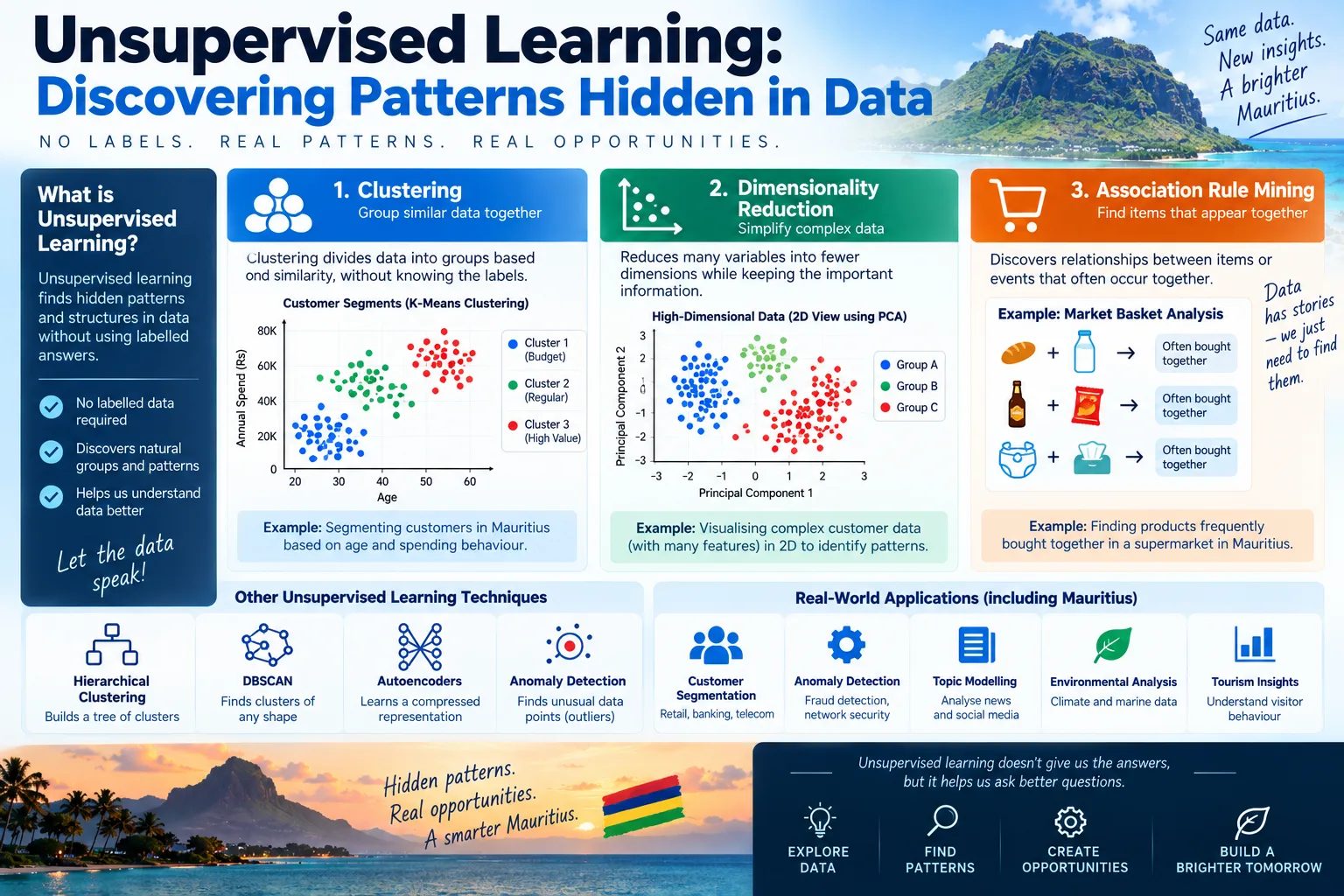
One of the main areas I explored was clustering.
Clustering attempts to organise observations into groups based on how similar they are to one another.
A common example is customer segmentation. Instead of manually deciding what types of customers exist, we can use characteristics such as purchasing behaviour, spending patterns or product usage and allow a clustering algorithm to identify possible groups.
During the module, I learned about techniques including K-Means Clustering and Hierarchical Clustering.
K-Means works by dividing observations into a chosen number of clusters. The algorithm repeatedly adjusts the groups so that observations within each cluster are as similar as possible.
Hierarchical clustering takes a different approach by building a hierarchy of relationships between observations. This can be represented using a dendrogram, which provides a useful visual way of seeing how different observations or groups are related.
Working with both approaches showed me that there can be several ways of looking for structure within the same dataset.
Reducing Complexity With PCA
Another important topic was dimensionality reduction.
Real datasets can contain a large number of features, and this can make them difficult to analyse or visualise.
We explored Principal Component Analysis (PCA) as one way of reducing that complexity.
Rather than simply deleting columns, PCA transforms the original features into a smaller number of components that capture as much of the important variation in the data as possible.
This was particularly useful for understanding how a dataset with many dimensions can be represented in a simpler form.
It can also make visualisation easier. Humans cannot easily visualise data across dozens of dimensions, but reducing those dimensions can help reveal patterns that would otherwise be difficult to see.
Evaluating Something Without a Correct Answer
One of the more interesting challenges with unsupervised learning is evaluation.
In supervised learning, evaluation can be relatively clear. We have known answers and can compare the model's predictions against them.
With unsupervised learning, there may be no correct set of clusters to compare against.
If an algorithm divides customers into four groups, for example, how do we know whether those groups are actually meaningful?
This means evaluation has to be approached differently.
We can examine how well separated the clusters are, how similar observations are within each cluster, and whether the resulting groups make sense in the context of the problem.
This taught me that a mathematically well-defined cluster does not automatically make it useful.
The result still needs interpretation.
Small Decisions Can Change the Result
The module also showed me how much data preprocessing matters.
Algorithms such as K-Means rely on distances between data points. If one feature contains values between 0 and 1 while another contains values in the thousands, the larger values can have a much greater influence on the clustering.
This is why feature scaling can be particularly important.
Parameter choices matter as well.
For K-Means, choosing the number of clusters can change the structure that the algorithm discovers. Different features, scaling methods and parameters can all produce different results from the same original dataset.
This made unsupervised learning feel less like pressing a button and discovering a hidden truth, and more like an exploratory process that requires judgement.
From Prediction to Exploration
What I found most useful about Unsupervised Learning was that it changed the type of question I could ask of data.
Supervised learning often starts with:
"Can I predict this?"
Unsupervised learning can start with something much broader:
"What is happening in this data?"
That might mean discovering groups of similar customers, identifying unusual observations, reducing the complexity of a dataset or finding patterns that can later be investigated in more detail.
The algorithm does not necessarily provide the final answer. Instead, it can point us towards structures worth exploring.
What I Took Away From the Module
Unsupervised Learning showed me another side of machine learning.
Not every useful machine learning problem needs a target variable or a known outcome.
Sometimes the purpose is simply to explore.
Techniques such as K-Means, Hierarchical Clustering and PCA provide ways of looking at data from different perspectives and finding structure within information that initially appears unorganised.
For me, the most important lesson was learning that discovering a pattern is only the beginning.
The next question is whether that pattern actually means something.

Join the conversation
Loading comments…